
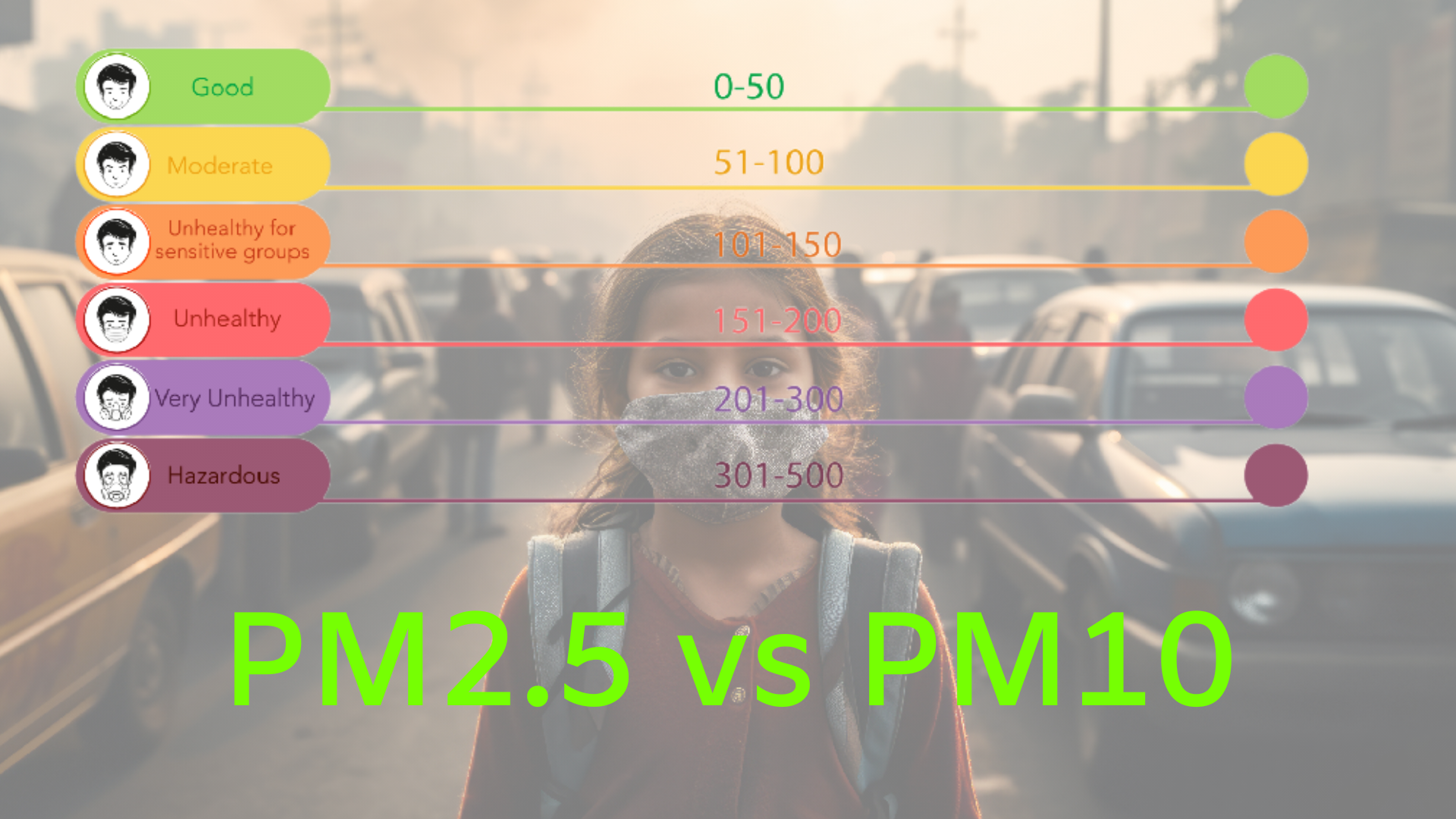
PM2.5 vs PM10: The Invisible Enemies in Your Air Explained
You check the AQI and see “PM2.5” and “PM10” as the main culprits. But what do these numbers mean? Why is one considered more dangerous than the other?
Think of it like this: Not all dust is created equal. The size of a particle determines how far it can travel into your body and the damage it can cause.
Let’s break down the battle of PM2.5 vs PM10 in simple terms.
The Core Difference: It’s All About Size
The number (2.5 or 10) refers to the particle’s diameter in micrometers (µm). To give you some perspective, a single strand of human hair is about 50-70 micrometers thick.
- PM10: Particles with a diameter of 10 micrometers or smaller. (Think of fine dust or sand.)
- PM2.5: Particles with a diameter of 2.5 micrometers or smaller. Also known as “fine inhalable particles.” (Think of something much finer than a human hair.)
Simple Analogy: If a PM10 particle were the size of a soccer ball, a PM2.5 particle would be the size of a tennis ball. This size difference is everything.
Head-to-Head Comparison: PM2.5 vs PM10
| Feature | PM10 (The “Coarse” Particle) | PM2.5 (The “Fine” Killer) |
|---|---|---|
| Size | ≤ 10 micrometers (µm) | ≤ 2.5 micrometers (µm) |
| Source | Dust from roads, construction sites, landfills, pollen, mold spores. | Vehicle exhaust, power plant emissions, industrial burning, forest fires, chemical reactions in the atmosphere. |
| How Far It Travels | Can stay in the air for minutes to hours. Travels shorter distances. | Can stay in the air for days or weeks. Travels hundreds of miles. |
| How Far It Goes in YOU | Gets trapped in your nose and throat. Can cause coughing, sneezing, and asthma attacks. | Bypasses your body’s defenses. Penetrates deep into your lungs and bloodstream. |
| Health Effects | Short-term: Eye/nose/throat irritation, coughing, sneezing. Long-term: Worsening of asthma and bronchitis. | Short-term: Chest tightness, shortness of breath. Long-term: Heart attacks, strokes, lung cancer, diabetes, and permanent damage to lung function. |
| Visibility | Contributes to hazy skies. | The main cause of smog and reduced visibility. |
The Journey Inside Your Body: A Visual Story
This is why PM2.5 is the bigger worry:
- PM10’s Journey: When you breathe in PM10, your body’s first-line defenses—like the tiny hairs in your nose (cilia) and mucus—act like a security system. They trap these larger particles. You then expel them by sneezing or coughing. They irritate, but are often stopped.
- PM2.5’s Invasion: PM2.5 particles are so small they slip past these defenses like invisible ninjas.
- They travel deep into your lung’s alveoli (the tiny air sacs where oxygen exchange happens).
- From there, they can pass directly into your bloodstream.
- Once in your blood, they can travel to your heart, brain, and other organs, causing widespread inflammation and damage.
Bottom Line: While both are harmful, PM2.5 is far more dangerous because it causes systemic damage throughout your entire body, leading to severe long-term health problems.
Where Do They Come From? Sources in India
Understanding the sources helps us see the bigger picture:
- PM10 in Indian Cities: Largely from construction dust (everywhere!), road dust, and open waste burning.
- PM2.5 in Indian Cities: The deadly mix comes from vehicle emissions (especially diesel), industrial pollution, crop burning (parali) in neighboring states, and the burning of fossil fuels.
How to Protect Yourself from Both
- Check the AQI Daily: Don’t guess, know! Use reliable sources like the Live AQI Map on IndiaPollution.com to see the levels of PM2.5 and PM10 in your area.
- Wear the Right Mask: On bad air days (AQI >200), a simple cloth mask is useless. You need a well-fitted N95 or N99 mask to filter out these tiny particles.
- Invest in an Air Purifier: Ensure it has a true HEPA filter, which is capable of removing over 99% of both PM2.5 and PM10 particles from your indoor air.
- Avoid Outdoor Activities: When the AQI is in the ‘Red,’ ‘Purple,’ or ‘Maroon’ zone, postpone your jog, skip the sports game, and opt for indoor exercises.
- Keep Indoor Air Clean: Keep windows closed during high pollution hours. Use exhaust fans while cooking and regularly vacuum with a HEPA-filter vacuum cleaner.
Knowledge is Your Best Filter
The key takeaway is simple: PM2.5 is the silent, deeper threat, while PM10 is the obvious irritant. Both demand our attention, but PM2.5 requires serious caution.
By understanding the difference, you can make smarter decisions for your health. Check your air quality, take the right protective steps, and share this knowledge. Because everyone deserves to breathe easy.
👉 Check the PM levels in your city right now on IndiaPollution.com and breathe informed!